Wednesday, 15 February 1984

Feminine Makeup


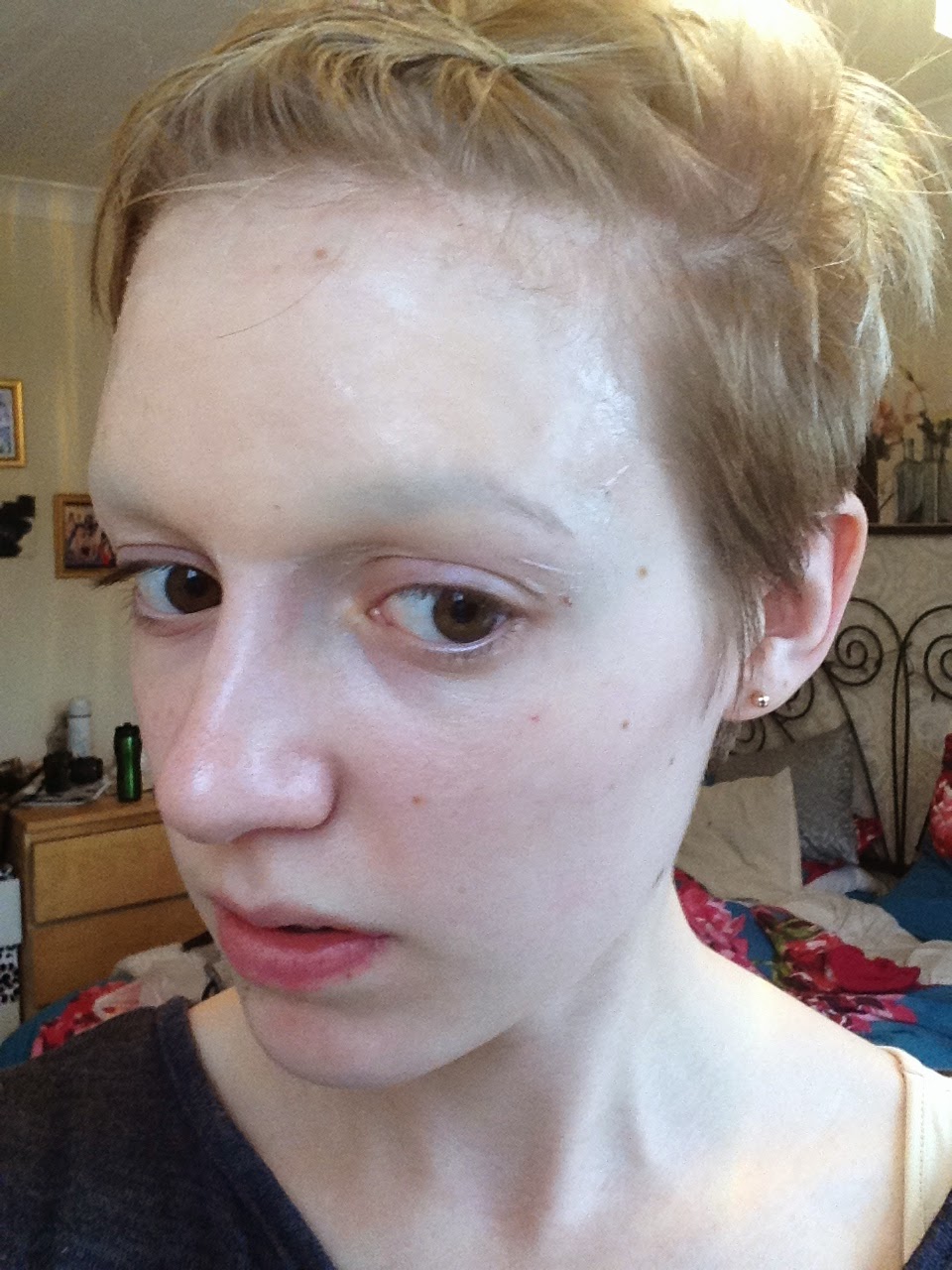
I wanted to see how normal, everyday girls makeup alters a boys face without the use of prosthetics or drag style makeup. It is a common thought in modern society that makeup is only for women and shouldn't be worn by men and that wearing it is socially unacceptable. This fits into the ideas in post-modern feminism that we believe about how genders should behave and gender stereotypes are socially constructed so that we behave 'normally'. A large amount of women where a certain amount of makeup everyday and I wanted to apply this level to a boy to see if it made them look more typically 'feminine'.


Model before applying makeup


In doing this I discovered that eyebrows make a massive difference to how masculine or feminine a face looks. The eyebrows make the eyes look more closed and the brow look heavier because they are thick and shapeless, both of these traits being more typically masculine. I was very happy with the foundation and concealer as this improved the models skin a lot. I kept the eye makeup quite simple which worked well for the look but next time I would curl the models eyelashes as I didn't do this and I think it makes a lot of difference to the overall look. I also was happy with the contouring, especially on the nose as it made the face appear more feminine and the nose look smaller and more turned up. All together I feel the makeup did make the fame look a lot more typically feminine but as it wasn't drag makeup and I left things like the eyebrows you can still tell very clearly that the model is a boy. This helps me to realise what it is about male and female faces that make them different and it's not as simple as the adding or the absence of makeup.

Tuesday, 15 February 1983

Prosthetic Brow Piece

Through my research of the difference between men and women's face I found that a main feature that alters the face from a man to woman is a heavier brow bone. Men normally have a heavier brow bone than women making their eyes look more sunk in. I will experiment creating this look with highlighting and shading but I wanted to try also creating a prosthetic brow piece. I sculpted a flat piece that was the size of a forehead that makes the brow bone slightly heavier and adds a slight crease above the eyes. I then cast it in silicone encapsulated in cap plastic.


I was very happy with how this turned out as I think it's a very subtle piece that will make a small difference to alter the face. The edge of the piece is mostly good apart from one small fold at the bottom but that can be torn close to the silicone as it's being glued above the eyes. I am very happy with the texture of this piece as I think it's subtle but skin like with the very fine pore detail.


This was the piece once it had been applied. Overall I was very happy with it as it is a subtle piece but I feel the small difference it made is effective. The was extremely happy with the edges and blending of the piece as they are barely noticeable, especially around the top of the forehead. I think it also did the job of making the brow bone look slightly heavier and further forwards although it could have been slightly bigger and still have looked natural. It made my eyes look deeper set which is another feature that men have different to women so this was an advantage of the piece. I would definitely consider using this in a female to male transformation makeup and if it were to be in a full makeup I would colour the piece with red tones to match the skin and lay eyebrows on over the top.

Friday, 19 February 1982

Transgender Children

From my research into the variations in male and female faces I learnt that pre-pubescent children are very similar in how there faces are made up and can easily be mixed up without the markers of hair and clothing. This is an interesting aspect of gender research because  it questions what does make us certain genders - are we born knowing gender norms or are they imposed by society and only our sex is set in stone? Something which shows this question is gender dysphoria in children. It's said in one documentary that we begin to understand our gender identities around age 3 and children as young as this have shows signs of having gender dysphoria and some have been diagnosed as young as 5.

Gender dysphoria is a condition where a person experiences discomfort or distress because there is a mismatch between their biological sex and their gender identity. It mostly happens in teens but can occur in children, and this causes a lot of dispute about whether children should be able to identify as the gender they feel they are.


46 - Zach Avery


47 - Jazz Jennings aged 6


48 - Jazz Jennings aged 11


The following videos helped me to better understand transexuals and gender dysphoria in children and see first hand that pre-pubescent boys and girls faces are practically identical. In all the cases it is impossible to tell that the children are the opposite gender.

49

This documentary was most interesting in it's focus on the parents reaction to their children's gender dysphoria as I feel it shows how society often feels about our discomfort with gender that doesn't conform to norms.
50

I think this is one of the most powerful documentaries in Jazz's very early diagnosis of gender dysphoria. It is clear from this documentary that it isn't the parents influence that made the child believe they were the wrong gender as some people believe but came completely from the child. It is also very powerful seeing how self-aware Jazz is at such a young age and her strong beliefs in people choosing to be whatever gender and sexuality they want to be.

51

The most powerful part of this documentary was the description of the girl going to cut her penis off with nail scissors and the mother saying to the interviewer 'I'd rather have an alive daughter than a dead son'. Suicide is almost 4 times higher in transgender people and the mothers support in this documentary was very moving.

 Seeing these cases where children idenitified with the opposite gender from as young as 3 is evidence I feel towards the post-modern feminist theory that gender isn't based on sex but is a socially constructed concept. The children didn't have any knowledge of the transexual community before identifyinhg strongly with the opposite gender. It also helped to see how strongly boys and girls look the same before puberty and that what gender we assume a child is is based on the outward appearance of their hair and clothes. This makes me want to explore later on doing a makeup on a younger child that takes away their gender identifiers eg. hair to see the difference in how they look.